
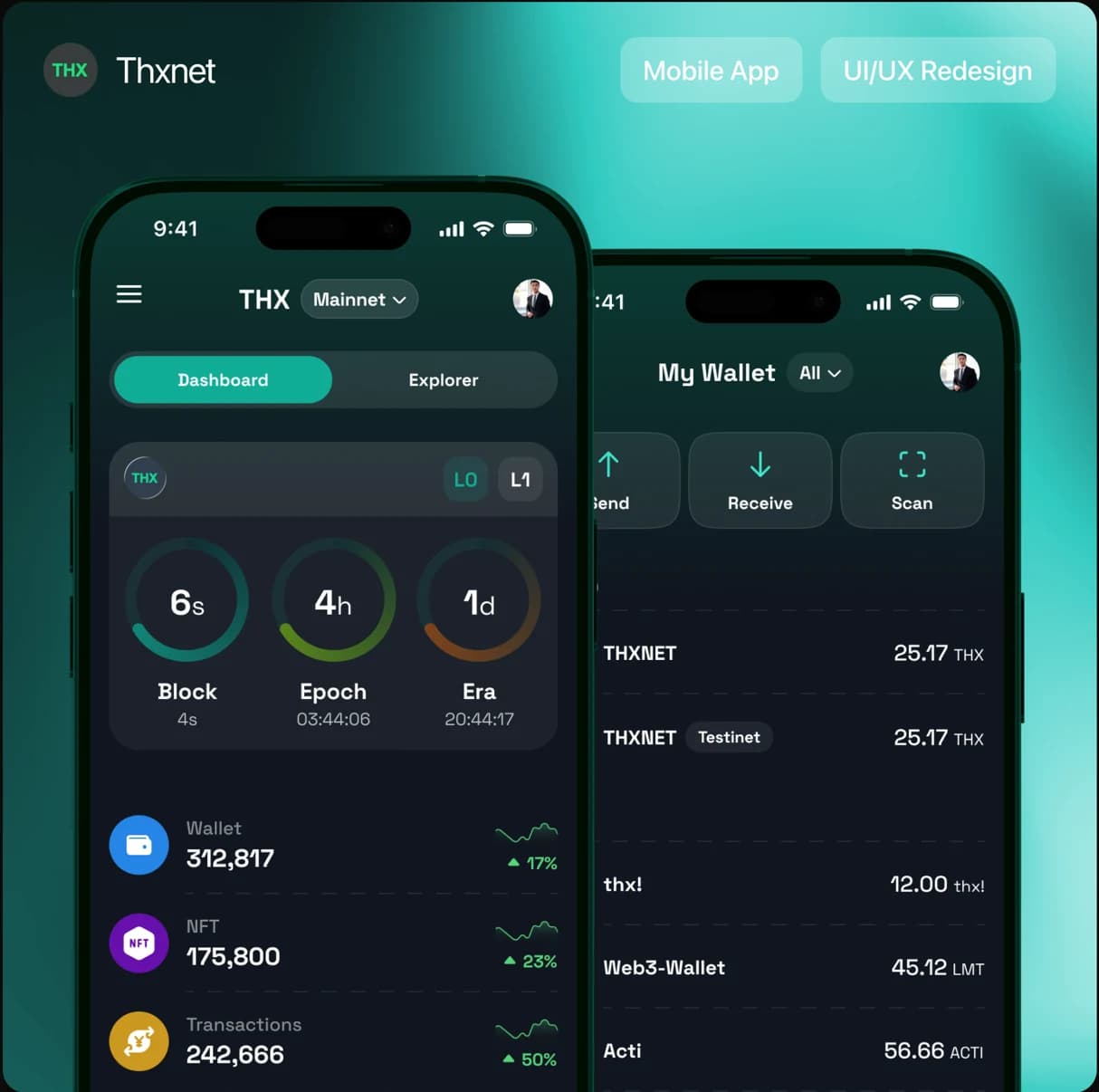
- 60+screens and states redesigned
- 40+components in the Figma library
- 7 weeksfrom audit to developer hand-off
About the project
THXNET is a blockchain network from THXLAB in Tokyo and Singapore, built on a customised Polkadot Substrate. A Layer 0 root chain secures Layer 1 chains that companies run for their own products, and one ID-Wallet holds assets across all of them.
We redesigned the THXNET wallet app: the network dashboard, the explorer and the wallet, with a mainnet and testnet switch, in one dark design system.
The challenge
The app serves two audiences at once. Developers and THX holders open it for network data: block times, epochs, eras and the explorer. Customers of the companies building on THXNET open it to hold and send tokens, and shouldn't have to learn what a root chain or a leaf chain is first.
One wallet also holds tokens from the root chain, its testnet and every company chain. Without clear cues it's easy to lose track of which chain a token lives on, or whether a balance is real money or test money.
Our role
Nemy's design lead and a product designer worked with THXLAB's product and engineering teams for seven weeks. We audited the existing app, redesigned the dashboard, the explorer and the wallet, and built a component library in Figma, then stayed on call while THXLAB's engineers built it.
What we designed
- Dashboard: a mainnet and testnet switch, Layer 0 and Layer 1 views, and network totals for wallets, NFTs and transactions, each with its trend
- Network timers: block, epoch and era as rings, with the target length inside and the live time underneath, so the network's pace reads at a glance
- Explorer: blocks, transactions and accounts, one tap from the dashboard
- Wallet: send, receive and scan at the top, then a balance for each chain (the THXNET root chain, its testnet and company chains such as thx!), each in its own token
- Design system: a dark theme with one teal accent, built for dense data and long sessions
The web3 UX we solved
- Layers: an L0 and L1 toggle instead of jargon, and a wallet that lists the root chain first, then each company chain with its own token
- Mainnet and testnet: a network switch that's always in view, and a Testnet badge on every test asset, so test tokens never look like real money
- Addresses: the ID-Wallet has two address formats, Substrate (SS58) and Ethereum-style; Receive shows the right one for each chain with a QR code, and Scan reads both
- Signing: every transfer ends on a confirmation that names the chain, the fee and the balance after you sign
- Context: the account and the network stay in the header on every screen, so you always know where you're acting
What we handed over
THXLAB's engineers got the Figma library, a clickable prototype of the main flows and notes for every state: loading, empty, error, pending and confirmed. We reviewed their builds against the designs during implementation, so the shipped screens match the files.
- What we did
- Wallet app UI/UX redesign
- Category
- Blockchain · Wallet
- Platform
- Mobile app
- Timeline
- 7 weeks
- Team
- Design lead, product designer
- Stack
- Figma
- Services
- Web3 & crypto apps
Building something like THXNET?
Tell us about it on a 15-minute call.
More work
 Celia WalletMulti-chain crypto wallet for six networks
 EeseeLaunchpad, tiers and staking for a Web3 marketplace
 Crypto WalletSelf-custody wallet and crypto portfolio app
 ForeverHerDoctor-prescribed GLP-1 weight care for women